|
BAALMILK II.
B ‘ l m l k (fen),
Ba-(‘-)al-ma-la-ku (akk), Balmalakos (gr).
Koning van Kition en Idalion in de 2e helft van
de 5e eeuw v.C.
Wellicht begint zijn regering al rond of net na de
gebeurtenissen in 449 v.C bij de vergeefse belegering van Cimon op Kition,
maar er zijn ook latere dateringen.
In ieder geval verschijnt er tijdens zijn regering een
niet nader gedateerde wijdings-inscriptie aan Astarte en in het derde
regeringsjaar een wijdings-inscriptie aan ‘Anat. Deze laatste inscriptie in
de vorm van een lange regel van 1,25 meter, welke werd gevonden in 1887 in de
kerk S.Giorgio, geeft inzicht in de stamboom van de regeerders van Kition en
Idalion.
Tekst: “---- in de
m]aand van MRP’M in het 3e jaar van zijn regering, van Baalmilk,
koning van Kition en Idalion, zoon van Azbaal, koning van Kition en Idalion,
zoon van Baalmilk, koning van Kition, heeft deze muur gewijd ----- Azbaal,
koning van [Kition en van] Idalion, zoon van Baalmilk, koning van Kition,
voor zijn vrouwe Anat, opdat ----- “
Zie: o.a.
Magnanini (Cyp2magna11).
Tijdens de regering van deze Baalmilk II krijgen de Feniciërs
ook weer de controle over Salamis. Een inwoner van Kition, Abdemon, komt daar
waarschijnlijk in 424/3 v.C op de troon als gevolg van de bepalingen van het
Epilycus-verdrag, dat Darius II met Athene afsloot. Theopompus uit de 4e
eeuw v.C schrijft hierover (FGH II B par.115 frag.103).
In 412/11 verjaagt Evagoras I Abdemon al weer van de
troon. Een paar jaar eerder komt er volgens Lipinski (Itineraria blz 93) ook
al een eind aan de regering van Baalmilk II (c.415 v.C).
|
BAAL MILK II.
B 'lmlk (Phoe), Ba - (‘-) al-ma-la-ku (akk), Balmalakos (gr). King of Kition and Idalion in the 2nd half of the 5th century BC Perhaps government starts around or just after the events in 449 BC at the futile siege of Kition by Cimon, but there are also later dates. In any case, there is an undated dedication-inscription to Astarte during his reign, and in the third year of his reign a dedication-inscription to Anat. The latter inscription is in the form of a long line of 1.25 meters, which was found in 1887 in the church S.Giorgio, and that provides insight into the genealogy of the rulers of Kition and Idalion. Text: "---- in the m]onth of MRP'M in the 3rd year of his reign, from Baal Milk, king of Kition and Idalion son of Azbaal king of Kition and Idalion, son of Baal Milk, king of Kition , this wall was dedicated ----- Azbaal king of [Kition and] Idalion, son of Baal Milk, king of Kition, for his mistress Anat, that ----- " See: among others Magnanini (Cyp2magna11). During the reign of this Baal Milk II the Phoenicians also regain control of In 412/11 Evagoras I chases Abdemon away from the throne. A few years earlier, as Lipinski (Itineraria 93) states, tere comes an end to the reign of Baal Milk II (c.415 BC). |
dinsdag 19 augustus 2014
Baalmilk II

dinsdag 15 juli 2014
Elibaal

On a statue of Orsonkon the farao.
Elibaal was the king of Byblos in the 10th century BC.
ncfps

Shapatbaal

Second oldest Phoenician inscription.
Remarkable are the dots between the words. Normally the Phoenicians wrote everythong after eachother.
From Felsenbild bis .....
Földer-Papp
ncfps
Abdo

Von Felsenbild zur .....
Földer-Papp
De oudste Fenicische inscriptie?
Het is de vraag of de datering wel juist is. Dit kan een paar eeuwen later zijn.
donderdag 10 juli 2014
Abdmelqart extra

Inscription of Abdmelqart of Carthage 3rd-2nd century BC. Every sign is different.
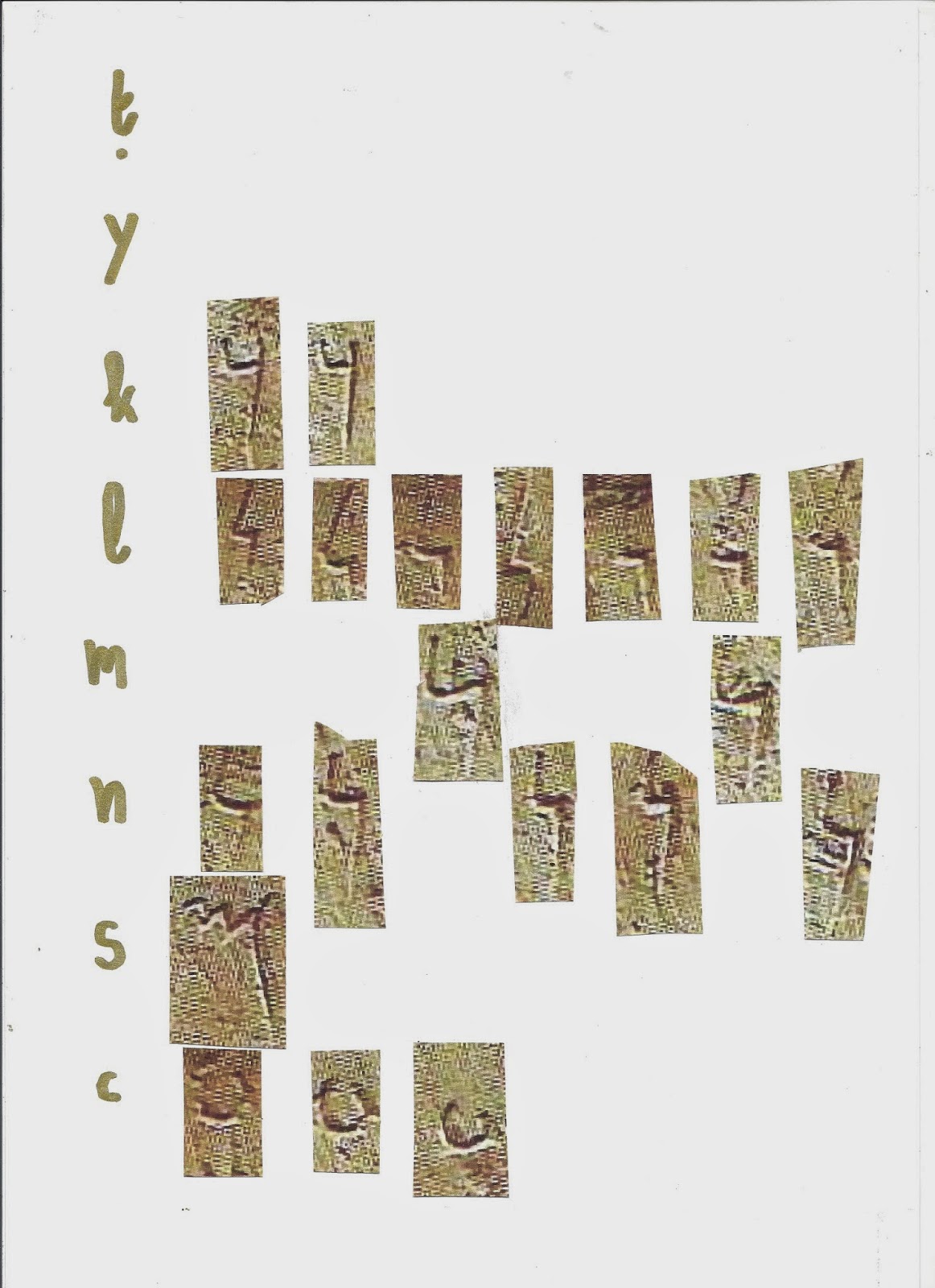
Especially the difference between de L and N is hardly to see.

Not all the signs of the alphabet are in the inscription. The H, Z, S., T., and Y are missing.
Abdmelqart van Carthago
Op zijn gedenksteen ter ere van Tanit en Baalhammon staat ook een afbeelding van een schip. Goede kans, dat de man in de 3e-2e eeuw v.C een zeeman was. Zijn voorouders zijn Gersakon en Himilkat.

On his stone dedicated to Tanit and Baal Hammon is also a picture of a ship.

aan de vrouwe / to the lady

aan tanit to tanit

gezicht van / face of

baal

en aan / and to

de heer / the lord

baal hammon

dat gewijd werd door / which was dedicated by

abdmelqart

zoon van / son of

gersakon

zoon van / son of

himilkat

Abonneren op:
Posts (Atom)